
Six Things About Writing

First: A huge huge huge congratulations to my friend Maura McHugh, who won the World Fantasy Award last weekend for her short story “Raptor” in the anthology Heartwood (which also garnered a World Fantasy Award for its editor, Dan Coxon). Also, go and check out this app that my friend George made, a journal that turns your words into art: Bloom.
All writing advice is bullshit, except when it isn’t. The problem is that in order to winnow out the bullshit from the useful, you have to be so experienced that you no longer need the advice.
The reason writers relentlessly pound the advice drum of read a lot, write a lot is that in the end, that’s really what it comes down to. There’s no magic or hack or one great trick to get you there. There’s no formula despite what you may have read about Malcolm Gladwell’s 10,000 hours to mastery, a number he apparently didn’t quite pull entirely out of his ass but might as well have; or some spreadsheet-addled writer’s assertion that you have to write a million words of garbage to get to the “good stuff”; or anyone’s insistence that you have to go to the Iowa Writer’s Workshop or Columbia or Clarion or Odyssey or pay anyone anywhere any money to learn how to write1. You can do all of those things, or none of those things, and they may or may not help you, and in some ways they may hinder you, so the key here is to pay attention to yourself and what is and isn’t working for you. No one else has your vision. Don’t let anyone rob you of your unique voice to make you more “sellable.”
If you want to be a great writer, you really do have to read a lot, and read widely. That means outside of your chosen genre (“literary” and “mainstream” are also genres!), books in translation, books from all different time periods. That means reading the canon, if you’re writing in English—because all of Western literature is in conversation with the canon one way or another—and reading way outside the canon, way way outside. Read the writers your friends told you are “problematic” (and get new friends). Read the writers people recommend to you and the ones they don’t. Read books by writers who were nice people in their personal lives and read books by writers who were absolute monsters. If you love what you read or hate what you read, ask yourself why. In the early days, reading things you hate or that are just mediocre can be helpful because you can study how writers go wrong. Do you need to study what you read all of the time? Make notes? Eh, I dunno. Whatever works for you? If you want to? If you don’t want to, just read, because you will absorb it into your bones and your flesh and your blood as though it’s your DNA. I am largely a reader and not a note-taker at all, but one thing I have done in the past is study some of the writers in my personal canon of the weird to examine exactly how they produce that off-kilter sense of strangeness filtering into the everyday: Shirley Jackson, Elizabeth Hand, Ramsey Campbell, M. John Harrison, Alan Garner, Caitlin R. Kiernan, and Robert Aickman have all been among my guiding lights in this endeavor. But mostly, I just read, and mostly, you should read the best writing you can get your hands on. Many many years ago, I read an interview with the writer Kathe Koja in which she observed on the matter of reading as a writer, “If you eat Wonderbread, you shit Wonderbread,” and this has never left me.
And write. It doesn’t matter when or how. It doesn’t matter if you do it every day, if you count words or hours or pages written, if you use longhand or a typewriter or Word or some fancy software program or Google docs or your phone. It doesn’t matter if you do it for an hour or fifteen minutes, in a cafe or a quiet room or standing in line at the grocery store. But you have to do it consistently, and you have to do it a lot.
Reading a lot and writing a lot won’t make you a good writer if you don’t have the spark of talent to begin with. This is a weirdly controversial take but it’s true and I know it’s true because I have known people and I’m sure you have too who write and write and write and they just don’t get any better. Some of those people persist for decades in fruitlessly sending out work; some self-publish; some get traditionally published and crash and burn; some get traditionally published and have great careers. Corollary: The state of your writing career and your actual ability to write well are not necessarily related.
The most important quality any writer can have is persistence. Absolute boneheaded thick-skulled imperviousness to the absolute boneheaded thick-skulled bullshit you will encounter over and over again as writer, not to mention the frustrations, heartbreaks, disappointments and betrayals, and that’s before your own self-doubt and self-recriminations get hold of you. The publishing industry is a garbage fire; other writers are assholes who would bludgeon you to death with the nearest-available award of their choice if they thought it would advance their own chances and will settle for trying to cancel you, through nasty little whisper networks if they’re cowards or overtly if they’re not (spoiler: it’s all cowardice); if you’re writing books, you’re only as good as the last thing you published. You will watch your peers have incredible luck that never happens to you. You will find out that writers, who of all people ought to champion free speech, only champion free speech when it works for them. (To those people, I prescribe a reading of Salman Rushdie’s brilliant Knife.) In the early days, you will get rejected, a lot. I used to paper the wall above my writing desk with them (this was in the days when editors sent out rejections in the old self-addressed stamped envelopes.) Not counting my occasional efforts as a teenager, I sent out stories consistently for a solid four years before I got my first “yes” from an editor. After that, for years, I managed the incredible feat of getting one “yes” a year. You will write stories that you think are among the best you have ever written and they will get published but go otherwise ignored by reprint anthologies and award bodies and readers in general. You will ask yourself why the fuck am I still doing this. You will watch writers who are far better than you, and far better than more-lauded writers, exit the field, or simply never get the recognition they deserve. You will see sycophancy get rewarded and quiet discipline and brilliance go unnoticed. It will not seem worth it. It isn’t worth it. But: there are also lovely people in the publishing industry (it’s still a garbage fire and probably always was and always will be); some of my favorite people and best friends in the whole world are fellow writers; I love writing and reading and telling stories and talking to other writers and talking about writing and reading and getting that yes from an editor and getting invitations to submit to anthologies from editors I respect and seeing my stories in print in beautiful books and alongside writers I love and that feeling when a story I’m writing comes together and I just know I’ve achieved what I wanted with it and getting so lost in the world of something I’m writing that the whole other world falls away and it’s just me and the words and the page and what I’m making and thinking about the books I loved as a child and feeling myself continuing in that tradition and reading my friends’ stories and seeing my friends win awards and words and books and books and words and stories and world without end, Amen. I love it. I love writing. I stopped, once, writing fiction, for three years, but I was writing other things (academic essays, a long thesis on three medieval English poems) and then I came back to fiction because Michael Kelly over at Undertow Publications (Undertow Publications didn’t exist yet) asked me for a story (it was the first time, nine years after my very first story appeared in the British magazine The Third Alternative, that an editor had solicited a story from me) and I wrote something called “The Moon Will Look Strange” having no idea that five years later it would be title of my first collection and then I just kept going even through stretches when I could barely write or finish anything at all. I would keep writing if my hands were on fire. I cannot think of a better or more utterly demented or foolish or passionate or beautiful way to spend my life. It is a transcendent love affair with the written word that won’t end until I am dead.
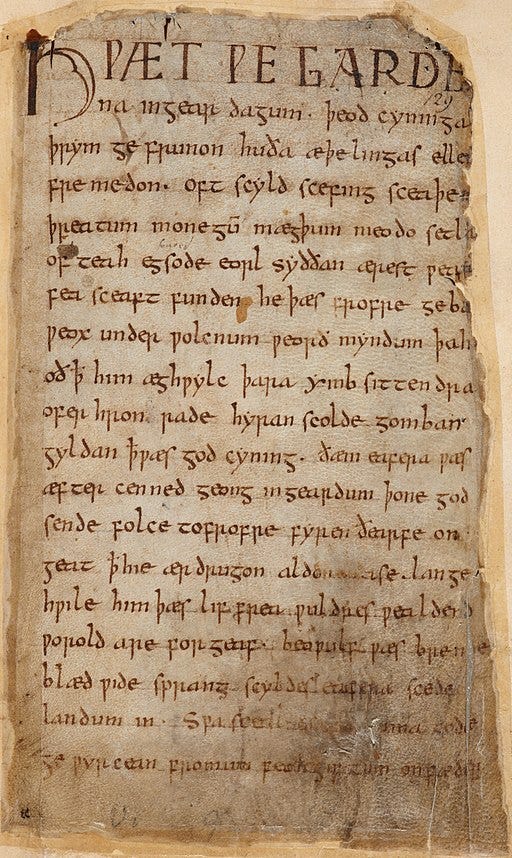
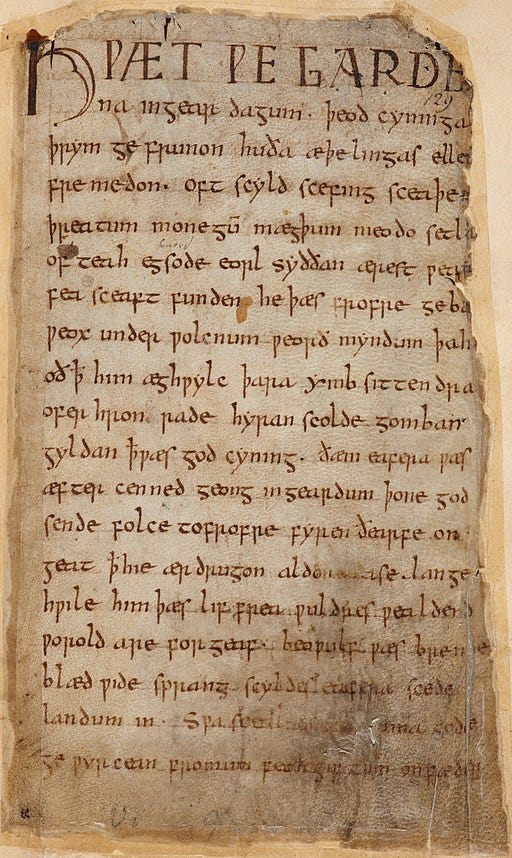
The Cotton MS Vitellius A XV Beowulf manuscript, first page Most writing advice focuses on craft and craft is important but craft alone will never make you a great writer. It can make you a good writer and a successful writer and that is enough for some people but I believe that if you are going to be a great writer, you must strike up a relationship with your unconscious and remain open to its bizarre and troubling wisdom. David Lynch’s ability to turn his own unconscious into words and images is one of the reasons I will always cite him as one of my greatest influences, and note as well that Lynch’s relationship with his creativity manifested in so many art forms: he wrote, he painted, he made cartoons, he made films, he made TV shows, he made weather reports, he was David Lynch, his whole life was an embodiment of Art. I love the work of Matt Cardin over at The Living Dark, who looks at creative expression as a kind of religious ritual, and who explores, in his words “how to live and create in full contact with the mystery at the heart of things.” I am 100% a pretentious wanker on this topic and I don’t care who thinks this about me.
All writing advice says more about the writer propagating it than about what you should do about your own writing. As William Goldman famously observed, “Nobody knows anything.” It’s a terrible cheesy cliche to say listen to your muse, but listen to your muse, listen to your daemon, listen to the worst thing that ever happened to you, listen to the fairies that used to stand round your bed when you were a child and whisper spells to you, listen to your madness, listen to what terrifies you, listen to the secrets you would never tell any living soul in a million years, listen to the moon, listen to people, listen to everyone who came before you, put your ear to the ground and listen to this ancient aching earth and all the stories it has held. And then turn it into words.
I have two new stories out! You’ll find “The King of the Gibbous Moon” in the middle grade anthology Scary Stories to Tell at Night, edited by Stephen Jones and illustrated by Randy Broecker. Also includes stories by Stephen King, Kim Newman, Robert Silverberg, Angela Slatter, Lisa Morton, and many more! (And if you can’t get enough of my spooky stories for kids, you can check out “The Sideways Lady” in Terrifying Tales to Tell at Night from 2019!)
My other new story, “Nixie,” is in the anthology Terror Tales of Chaos, edited by Paul Finch. We were each invited to contribute a story about a different elemental monster, and my story wonders what lies at the bottom of those ancient lakes all around Berlin.
Like my writing? Want more? Buy my books! I’ve written three collections of weird and ghostly short fiction: The Moon Will Look Strange, You’ll Know When You Get There, and Now It’s Dark. You should be able to buy them online or special order them from your favorite local bookstore. The links lead to my publisher’s page, where the second and third can also be ordered directly. Not sure you’ll like my fiction? Go here for a list of places where you can read and listen to it online for free. Here’s a more complete bibliography.
Looking for a manuscript evaluation or copyeditor? I do that too! Go here to find out more.
Need some copywriting done? Get in touch.
Disclaimer: I went to Odyssey. It’s the only writing class/workshop I’ve ever done (with the exception of once going to an hour-long workshop run by M. John Harrison in which I was so starstruck I sat there dumbly the entire time). Did Odyssey make me a better writer? Yeah, but in ways that were more qualitative than quantitative. (I initially wrote that as “more quantitative than qualitative” because I always get those two mixed up and I am a very good and smart writer.) Maybe I’ll write about that someday. Second disclaimer: People pay me to do manuscripts critiques. Can I make people better writers? Sometimes. If I don’t think I can make someone a better writer (including because I don’t think they need my services), I won’t work with them.
6 loud yeses. Let me say it louder. YES. As a big admirer of your writing, Lynda, always come here hungry and leave satisfied. Now I have to go do some more reading...
Excellent piece and huge congratulations to Maura McHugh. I’m writing a fair bit at the moment and have a pile of stories more or less finished but I’m so frustrated with the whole business that they’re going nowhere. After 30 years of being published I still feel like I’m in the ‘slush pile’ (horrible term) and I still haven’t been paid for the story I had published last year. But thanks for this piece - I sometimes forget that writers with a far higher profile/way more success than I’ll ever have also have their frustrations!