
This Time Tomorrow
love and death and traveling in time with Emma Straub

“It's okay to lose people. Loss is the point.”
-This Time Tomorrow, Emma Straub
Time travel stories have always been among my very favorite, from Antonia Barber’s The Ghosts (UK readers will know it as The Amazing Mr. Blunden) to Netflix’s Dark and so much in between. I love the work of Daphne Du Maurier, but my favorite book by her is not Rebecca or Jamaica Inn but The House on the Strand, in which the protaganist repeatedly travels back from the twentieth to the fourteenth century. Other favorite time travel novels as an adult include Jack Finney’s Time After Time, Stephen King’s 11/22/63, and Michael Bishop’s No Enemy But Time. Bishop’s book shares a prehistoric setting with another childhood favorite, Norma Fox Mazer’s Saturday the Twelfth of October, in which a teenage girl in Central Park in the 1970s suddenly finds herself in the same location only during the Stone Age.
Other vividly remembered favorites from childhood all happen in England: Mirror of Danger (Come Back, Lucy for UK readers), in which a sheltered girl in 1970s England travels back to Victorian times where she strikes up an increasingly perilous friendship with a girl named Alice; Time Tangle by Frances Eagar, which takes place in a convent school where a girl goes back to the sixteenth century (at about ten or so, I tried adapting this into a play); and Margaret J. Anderson’s To Nowhere and Back in which an American girl who has moved to England with her family travels to the nineteenth century where she becomes a girl named Ann who lives in one of the cottages that are derelict in the twentieth century.
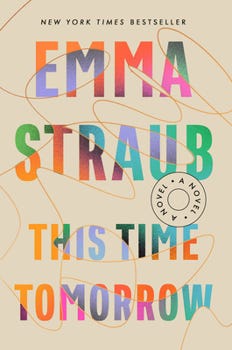
Emma Straub's novel This Time Tomorrow is more in the vein of the movies it ticks off than the novels I mentioned above—Groundhog Day, Back to the Future, Peggy Sue Got Married—that is, part drama, part comedy of manners rather than immersion into a historic time and place1. I’d been curious about reading her for a while since I loved the books of her father, Peter Straub, I used to like her Twitter feed when I used Twitter, and I enjoy her newsletter. The premise of This Time Tomorrow caught my attention: on the eve of her fortieth birthday, Alice wakes up to find that it’s the morning of her sixteenth—and yet, she can remember everything from her previous life.
This Time Tomorrow runs entertainingly with its time travel premise, but ultimately, this is a book about choices—the ones we make and the ones we fail to make and where that leaves us—and about the bond between a father and a daughter. And it’s a love letter to New York City. It is also about grief and losing a parent, which I didn’t know when I picked it up. Peter Straub died in 2022, and Emma Straub began writing the book after he endured a long hospitalization in 2020. He lived long enough to read multiple drafts of it. Peter Straub was not a single parent and Emma Straub was not an only child, and in the afterword, she says, Alice and Leonard are not Emma and Peter, “except when they are”—a sleight of hand that will be familiar to anyone who draws some of their writing inspiration from real life.
Leonard, Alice's father, is a writer who produced exactly one published novel, though he's never stopped writing. Time Brothers, his time travel science fiction novel, is a cult classic that spawned a popular TV series, so Leonard's in perpetual demand at science fiction conventions and liable to have the TV show's catch phrase (I think it was “to the future!”) shouted at him on the street. He was a single parent to his daughter, raising her in their apartment in New York City after Alice's mother left to do New Age-y things in California. Leonard is sweetly eccentric in a way that reminds me of several writers I know. There are also some very funny scenes set at a science fiction convention where Leonard is a guest, surely drawing on Emma Straub’s own observations of her father’s convention appearances.
What if she had actually enjoyed her father as much as she could every day?... What if she could fix everything that went wrong and he could live until he was 96 and die in his sleep?
In forty-year-old Alice’s life, Leonard is lying in a hospital bed, mostly unconscious, dying. For sixteen-year-old Alice, Leonard is young again.
Until she was diagnosed with lung cancer, I genuinely believed this was going to be the end that my mom got. And then after she died, I couldn’t stop wondering how I could have fixed things so that she could live until she was 96 and die in her sleep. What if she had quit smoking years ago? What if she'd had follow-up tests sooner, so the cancer had been found in stage 1 or stage 2 instead of stage 3? What if I'd done something different, or done more?
People were supposed to die when their loved ones could nod and grieve and say it was their time.
At 96. At 100. In their sleep. Not in their 70s or 80s, fighting all the way, not ready to go. It all still seems too soon. 96 and 100 would be too soon as well, though, wouldn’t it?
Not that Alice thought she had worked her way through it. If anything, she understood that it wasn't actually something one could ever work all the way through ... Grief was something that moved in and stayed. Maybe it moved from one side of the room to the other, farther away from the window, but it was always there. A part of you that you couldn't wish or pray or drink or exercise away. She was used to him being so close to gone that gone was almost desirable. No one wanted to watch someone they loved suffer. But she was also tired. Tired of how tense her body was when the phone rang, tired of how nervous she felt when she walked out of his hospital room, tired of how it felt to know that her life was going to change and that she was going to have this enormous hole forever soon.
Watching someone die is the most exhausing experience of my life—along with the knowledge of the grief that is going to consume you. Death is so relentless, and determined, and unexpected even when it is entirely expected. Against this implacable foe, it's horrifying how much the body fights. You want to say to it: Please, please, enough raging against the dying of the light. You are so tired. They are so tired. You want it to end but you don’t want to end because then it will be over, the person you love will be over.
This may sound like a grim novel, but it isn’t at all—it’s charming, and funny, and wise. It was in fact an enormous comfort to me, even if it made me teary-eyed once or twice.
Maybe there were endless opportunities for parties and for love if you built a life that made room for them.
That seems like a life well worth building.
I didn't have the relationship with either of my parents that Alice has with Leonard or that Emma and Peter Straub appear to have had—which I don't think is unusual; I think far more unusual is the bond I read about here. But what a glorious bond it is.
And then there’s this sentiment, which I have expressed more than once here myself:
He wasn't religious and so neither was she. Fiction, maybe, or art. Were those religions? Believing that the stories you told could save you, and could reach everyone you had ever loved?
I took the book back to the library after I read it, and so I can’t check this final note I made below. I know the first sentence is from the book, but I’m genuinely not sure whether the next two are me agreeing with her or someone else—her father, I guess—agreeing in the afterword.
Stories help always. Yes they do, Emma. Yes they do.
Yes they do. And this one did.
Over at Splinister, my friend Maura McHugh noted recently that time loop films have become especially popular in the 21st century.
The book sounds great! And thanks for the mention. ❤️
I have a lot I want to say about this but I can’t say it right now. My father was diagnosed with lung cancer a few months ago and now they think it’s in his brain and this post is like a vision into my future. My probably very real, near future and it’s all too much. I want to read this book, but maybe in a year or two. And I’m going to bookmark this post bc I think I’ll want to revisit it too at some point.