
A Portmanteau Post

Everyone loves a good misheard lyric, right? So that’s why I am starting this letter by telling you that it was only this past weekend, in the Year of Our Lord 2026, that I realized that the opening line of the song “I Think We’re Alone Now” by 1980s teen shopping mall pop princess Tiffany1 is not “Children of the air” but “Children behave” and I only figured that out, some 39 years after it first hit the airwaves, because I said to myself on Saturday “‘Children of the air’? What does that even mean?” and, suddenly realizing that couldn’t possibly be right, googled it.
Why this particular song was an earworm this weekend I will leave as an exercise for the reader (the only really acceptable explanation would be that I just rewatched the 1991 Martin Scorsese remake of Cape Fear in which an extremely creepy ex-con rapist Max Cady played by Robert De Niro croons, Ah thank we’re alone now at a teenaged Danielle [Juliette Lewis], daughter of his former lawyer and nemesis Sam Bowden [Nick Nolte] but alas, this is not the case).
I don’t know if “portmanteau” is really the right word to describe a semi-random collection of things but it is a word I have always liked for two reasons. One is that one of my favorite books a child was an absolutely bonkers one called The Portmanteau Book. I didn’t own a copy but I used to check it out at the library over and over, and all I can really remember about it is its anarchic spirit. I looked online and it seems that everyone else who’s encountered it has had an equally difficult time describing it. “Experimental fiction for kids” seems like probably the best assessment.
I also like the word because it makes me think of old-fashioned luggage, of which I am also very fond, although I am more of a backpack than luggage person myself.
Earlier this week, I started to write a different post about how it’s World Cup again and how that means I have been here far too long and that I watched so much of the last World Cup in waiting rooms and chemotherapy infusion suites, about how my mom loved sports and loved the World Cup, about the chemo nurse who also loved soccer and was so excited every time my mom turned up so they could talk about the tournament, about how they would switch the TV to World Cup for my mom. But I don’t think I have it in me to write any more about grief, or my dead mother, or about needing to leave. Not for a while, anyway.
But I will tell you one story, briefly. My mom was always extremely sensitive to any kind of medication. To the extent that medical professionals never believed either of us. So, she got a small dose of Benadryl as part of her weekly chemo infusion and it made her absolutely loopy. One day I left her alone in the infusion suite for a couple of hours after cautioning her, “Please, Mom, try to stay off politics, sports, and religion,” only to return and discover her, a tiny 83-year-old woman, high as a kite on Benadryl and walking all over the suite loudly announcing to anyone within earshot “I CAN’T STAND THAT CRISTIANO RONALDO. HE’S SO ARROGANT!”
I’ve read two nonfiction books recently that I would describe as “flawed but interesting.” The first was Abroad: British Literary Traveling Between the Wars by Paul Fussell, one of his lesser-known works (The Great War and Modern Memory from 1975 is probably the masterpiece for which he’ll be remembered). I read this partly as ballast for an article that I recently pitched and partly because it’s just a particular area of interest for me, I love that whole period of writers and travelers and travel writing in the 1920s and 1930s. Fussell’s thesis is that the horrors of World War I spurred what he believed to be the last great era of travel.
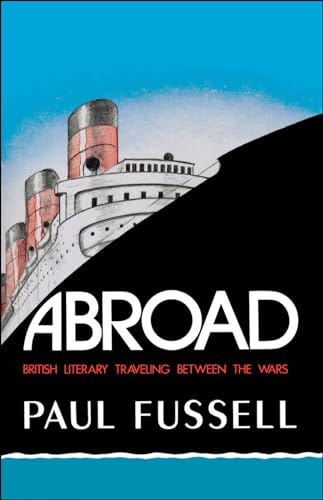
The book is uneven, with sections that I adored and others that were more of a slog. Most notably, I struggled through passages about Norman Douglas which treated his apparently voracious pedophilia with what felt like too light a touch, almost indulgently. I say this as someone who finds Art Monster discourse extremely tedious—this is way too big a subject to take on here, but suffice it to say I don’t actually really care what most artists were like in their personal lives, and I often find hand-wringing about these things to be mostly about people’s own self-regard and desperate desire to be seen as a good person on the internet (or terror of being cancelled lest they mention a bad person on the internet without the requisite throat clearing, not an unwarranted fear). I don’t think Douglas should have been ignored for this book if Fussell felt his work made him an appropriate subject, and I don’t think Fussell was secretly admiring him or anything, and I didn’t need him to pen an aside explaining that in fact pedophilia is bad, actually, as a contemporary writer might have done. At the same time, his approach felt cavalier, even for 1980, the year of the book’s publication, and even I was a little bit shocked by his treatment of what may have been less unacceptable in the 1920s and 30s but was no less criminal (and Douglas fled several jurisdictions to avoid prosecution). And yet, really, I’m also not sure what I think Fussell ought to have done differently with the material.
That aside, Fussell is more interested in Evelyn Waugh and DH Lawrence than I am—I’d have preferred more on Robert Graves, Patrick Leigh Fermor, and Lawrence Durrell myself. He also says that he’s left out Freya Stark because she was a great adventurer but not a great writer, which isn’t entirely unfair, but I’d still have enjoyed more Dame Freya than some of the other writers he chose to focus on.
But there were insights and passages in it that I absolutely loved:
But what [D.H.] Lawrence really saw in things and places was the infinite. Like all literary travelers worth reading, he played a spume of imagination upon empirical phenomena, generating subtle emotional states and devising unique psychological forms and structures to contain them. He “felt the urgency to describe the unseen so keenly,” says Rebecca West, “that he has rifled the seen of its vocabulary and diverted it to that purpose.”
Or there’s this, which causes me to reflect on what a very different world—traveling and otherwise—we inhabit one hundred years after the writers discussed in Abroad:
The speaker in any travel book exhibits himself as physically more free than the reader and thus every such book, even when it depicts its speaker trapped in Boa Vista, is an implicit celebration of freedom. It resembles a poetic ode, an Ode to Freedom. The illusion of freedom is a precious thing in the 20s and 30s when the shades of the modern prison-house are closing in, when the passports and queues and guided tours and social security numbers and customs regulations and currency controls are beginning gradually to constrict life. What makes travel books seem so necessary between the wars is what [Peter] Fleming pointed to in One’s Company, “that lamblike subservience to red tape which is perhaps the most striking characteristic of modern man.” Intellectual and moral pusillanimity is another characteristic of modern man.
Fussell died in 2012. I cannot help wondering what he (or Peter Fleming) would have thought of the nightmarish panopticon we were building for ourselves even then, which has only got so much worse since.
The other book I haven’t actually finished reading yet; it’s by a writer called Caroline Paul that I heard on a podcast ages ago and I recently found I’d written down her name and couldn’t remember why. (As an aside, Caroline Paul has a twin sister, Alexandra Paul, who is an actress apparently best known for Baywatch, but I have never seen an episode of Baywatch and when I think of Alexandra Paul, I always think of her as Leigh from the John Carpenter film Christine, based on the novel of the same name by Stephen King, a favorite from my teenage years in part because it was about teenagers.) Anyway, a little detective work revealed that I’d written “Caroline Paul” in a note to myself because I was interested in her 2023 book, which is called Tough Broad: From Boogie Boarding to Wing Walking—How Outdoor Adventure Improves Our Lives as We Age.
I have always said that I plan to live to be 100 and that I plan to be an 80-year-old woman who hikes up Kilimanjaro. Sections of this book are a lovely reminder that while none of us can say when our number will be up, “old age” doesn’t have to mean saying goodbye to adventure. While some of the activities profiled in the book count as “ways you could torture me and get me to admit to absolutely anything” (hello, BASE jumping and wing walking), I was particularly taken with no-nonsense 80-year-old scuba diver Louise Wholey, who spends a substantial portion of her time underwater doing work for ocean conservation organizations helping to restore reefs, which involves things like measuring kelp and counting fish, or removing garbage from the bottom of Lake Tahoe. When pressed by Paul about her age, particularly how others might view her, she is largely indifferent: “Well, when I got into my sixties, I started doing one-hundred-mile runs… On my seventieth birthday I finished the last of the 248 peaks in the Sierras . . . Does that answer your question?”
After Louise, we meet 93-year-old Dot Fisher-Smith, who attributes her vibrancy not just to a lifetime of walking as much as possible but of doing so on grass, in nature. At 73, she did a month-long Himalayan trek with a friend; at 75, she and her 77-year-old husband trekked Tibet’s Kora trail. She allows as how she had little sympathy for the frailty of the human body in others until she suffered her first real injury at 90, playing too enthusiastically with a dog and breaking her femur (she was out of the hospital a week later). Two years later, at 92, she hurt herself in a bicycle accident, which apparently finally slowed her down a bit.
Paul’s point is not that we all need to be extraordinary athletes or daredevils as we age—hence the chapter on accessible bird watching, which involves multiple people in wheelchairs—but that you really never are too old to learn new things and to engage with the natural world in some way, whatever best suits you. (“Does flying a machine count as outdoor adventure?” Paul wonders as she sets out to learn how to pilot a gyrocopter. This book isn’t about being prescriptive.) I have zero interest myself in adrenaline-jolting or dangerous physical activities—I don’t even like roller coasters, and although I love reading about mountain climbing, it holds zero appeal for me. I am hardwired for other types of adventures and physical challenges and though, and as someone who can never conceive of hanging up my traveling boots, this book profiles some women whose stories are very heartening to me.
There’s stuff I don’t love about the book and the way it’s written (some of it admittedly falling into the category of “criticizing the book she didn’t set out to write, so maybe write your own damn book”), but it’s a very easy read, and you can skip around in it for the bits that interest you most.
These women aren’t all lifelong athletes either. There’s a climber who didn’t take up the sport until she was in her sixties. There’s an aspiring swimmer who’s terrified of water splashing in her face. There’s a lousy surfer. It’s okay to have a hobby that you suck at. And there’s no suggestion that life doesn’t deliver setbacks: there’s grief and loss here, there’s a woman taking on guardianship for a minor relative in middle age; there’s a woman who has to modify or give up many of the activities she loved because of cancer and the aftermath of treatment.
But by all means, don’t let a broken world rob you of joy. Back over to Fussell:
Some of the most assiduous travelers of the 20s and 30s were those whose wanderlust the war had nearly extinguished. Sensing their predicament and understanding the urgency of their precious images of compensation, we will find nothing absurd in [Guy] Chapman’s intense, irrational happiness, even though he says, “I suppose there is something absurd about the intense happiness I get out of the simplest travel abroad.” His reason is simple and sufficient: “I must say I enjoy being alive.”
If you enjoyed this and would like to toss a few coins my way but don’t want the commitment of a paid subscription, you can send me a tip at Ko-Fi!
Like my writing? Want more? Buy my books! I’ve written three collections of weird and ghostly short fiction: The Moon Will Look Strange, You’ll Know When You Get There, and Now It’s Dark. You should be able to buy them online or special order them from your favorite local bookstore. The links lead to my publisher’s page, where the second and third can also be ordered directly. Not sure you’ll like my fiction? Go here for a list of places where you can read and listen to it online for free. Here’s a more complete bibliography.
Looking for a manuscript evaluation or copyeditor? I do that too! Go here to find out more.
Need some copywriting done? Get in touch.
I know this is originally a Tommy James and the Shondells song, but it’s a Tiffany song for me.
Oh I thought it was "children beware". Or possibly. "Children! Beware." But Children of the Air sounds like a Tanith Lee short story and I want to read it.
I also plan to live in good health and spirits for another 46+ years, although possibly wine and cake will lop a few years off :)
I will always remember Candace Bergin's line "Gladly the cross-eyed bear", but my own misheard lyric is from a song by Lord of the Lost: actual words are Goddess of the Void, which I heard as "God is self-employed".